Water scarcity is a global problem. Nearly 2.3 billion people live in water-stressed countries, with the most severe shortages in regions like Sub-Saharan Africa and the Middle East.
In the Middle East, water scarcity has reached critical levels due to the region's arid climate and rapid population growth. Our municipal client, Katara Cultural Village Foundation in Qatar, faced the dual challenge of conserving freshwater while meeting its substantial water needs for irrigation and district cooling. Additionally, Katara needed to align its water usage with Qatar's National Vision 2030, which emphasizes sustainable resource management.
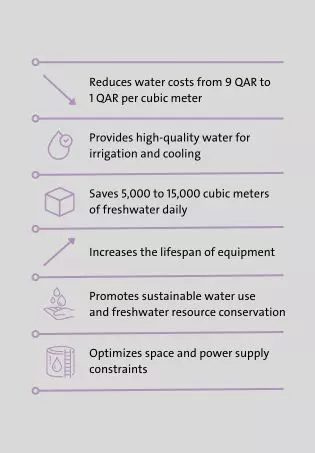
To address these challenges, our experts proposed a treated sewage effluent polishing plant to save up to 15,000 cubic meters (m3). The solution includes a four-train ultrafiltration process followed by a two-train reverse osmosis technology, reducing water costs from 9 QAR to 1 QAR per cubic meter.
Previously, Katara relied on desalinated seawater for park irrigation and cooling towers while TSE from the nearby Doha North plant — also operated by Veolia — was discharged into the sea, wasting a potential resource. By implementing an additional treatment step, we transformed this TSE into a valuable water source.
As well as promoting sustainable water reuse and resource conservation, additional benefits include optimized space and power usage, high-quality water for irrigation and cooling and increased equipment lifespan.